


Workers Comp Audits
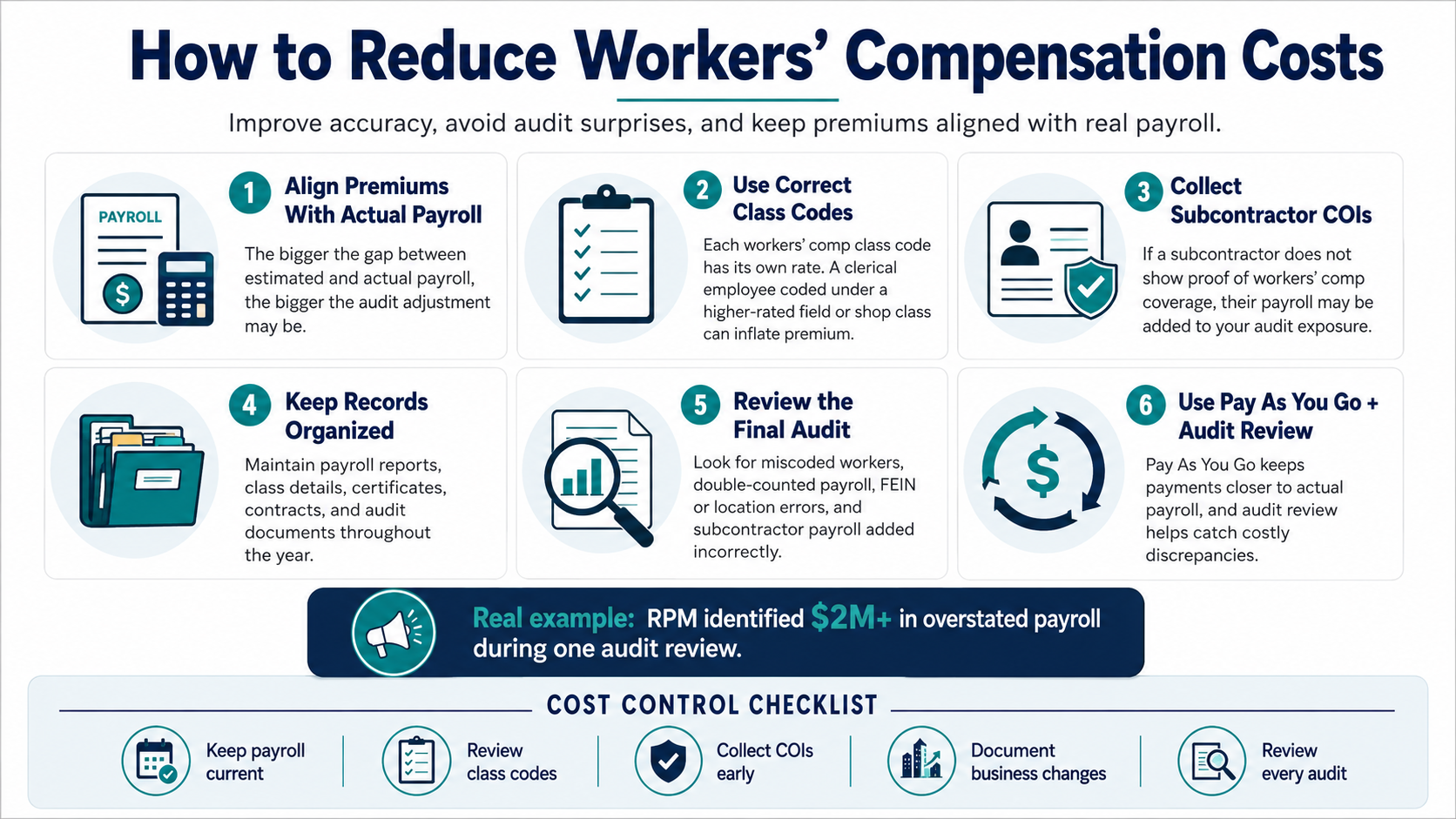
One of the most overlooked ways to control workers’ compensation costs happens at the end of the policy year: reviewing the premium audit itself.
Many business owners know that payroll, claims, and workplace risk affect workers’ comp costs. What they may not realize is that inaccurate payroll estimates, incorrect employee classifications, missing subcontractor documentation, or errors in an audit can also cause a business to pay more than it should.
Reducing workers’ compensation costs is not about cutting coverage or trying to make legitimate exposure disappear. It is about making sure the premium is based on accurate payroll, correct classifications, complete documentation, and a properly reviewed final audit.
For business owners, the biggest opportunities generally come down to five areas:
| Cost Control Area | Why It Can Affect What You Pay |
| Payroll reporting | A large gap between estimated and actual payroll can create a large adjustment at audit |
| Employee classification | Higher rated class codes applied incorrectly can increase premium |
| Subcontractor records | Missing proof of workers’ comp coverage can create additional premium exposure |
| Audit documentation | Incomplete information can make it harder to verify the final premium |
| Audit review | Payroll, classification, or reporting errors can remain in the final bill if no one catches them |
Here is how each one works.
1. Keep Workers’ Comp Premiums Aligned With Actual Payroll
Workers’ comp premiums are closely tied to payroll. At the beginning of a policy, the carrier may use estimated annual payroll to calculate the expected premium. The problem is that businesses rarely operate exactly as predicted for twelve months.
A company may hire more people, reduce hours, increase wages, lose a contract, win a large project, or experience seasonal changes. The larger the difference between estimated payroll and actual payroll, the larger the potential adjustment when the policy is audited.
For example, imagine a business expects $600,000 in annual payroll but finishes the year at $850,000. If premium payments were based primarily on the original estimate, the additional payroll may create a meaningful balance at audit.
The reverse can happen too. If payroll is substantially lower than projected, the business may have had more money tied up in premium payments during the year than necessary.
How Pay As You Go helps
Pay As You Go workers’ comp uses actual payroll data throughout the policy term.
With RPM, premiums are calculated each payroll cycle based on payroll activity rather than relying only on an annual estimate. This helps keep what the business pays during the year more closely aligned with what is actually happening.
The benefit is not simply that each payment is smaller. The more important benefit is alignment. When premium calculations stay closer to actual payroll, there may be a smaller gap to reconcile at audit.
Pay As You Go does not automatically reduce the rate charged for workers’ comp coverage. It helps improve the accuracy and timing of premium payments while supporting better cash flow.
2. Make Sure Employees Are in the Right Workers’ Comp Class Codes
Employee classification can quietly have a significant impact on premium. Workers’ comp class codes group employees according to the type of work they perform and the risk associated with that work. Each classification carries its own rate.
That means two employees earning the same wages can generate very different workers’ comp premiums if they perform different types of work. Consider an employee who performs strictly clerical duties in an office but is mistakenly included under a higher rated shop or field classification.
If that mistake remains in place all year, the business could be paying the higher rate on that employee’s payroll every time premium is calculated. The opposite issue can also appear during an audit. An employee may have been classified as clerical at the beginning of the policy, but their actual duties include regular operational or field work. An auditor may determine that a different classification applies, creating additional premium.
The important question is not simply, “What is this employee’s job title?”
It is, “What work does this employee actually perform?”
What business owners should do
Review classifications when the policy starts and again when employee responsibilities change. Pay particular attention when:
- An office employee begins performing operational work
- Someone moves into or out of the field
- New job functions are introduced
- A business adds a location or service
- Employees begin splitting responsibilities between different types of work
Correct classifications help ensure the rate being applied reflects the actual exposure.
3. Collect Workers’ Comp Certificates From Subcontractors
Subcontractors and 1099 workers are a common source of unexpected workers’ comp audit costs. The key document is the Certificate of Insurance, or COI.
A valid workers’ comp COI helps demonstrate that a subcontractor maintained their own workers’ compensation coverage while performing work for your business. Without appropriate proof of coverage, subcontracted work may create additional workers’ comp exposure for your business. Depending on the state, policy, and circumstances, the carrier may include some or all of that subcontracted labour when calculating premium.
That can create a substantial surprise at audit. For example, imagine a contractor pays several subcontractors over the course of the year but cannot provide valid workers’ comp certificates covering the periods when the work was performed. The auditor now has to determine whether those payments create exposure under the contractor’s policy. Simply having a 1099 does not answer that question.
The better approach
Collect documentation when the subcontractor starts working with you, not twelve months later when the auditor asks for it. Keep:
- Valid workers’ comp Certificates of Insurance
- Policy effective dates showing coverage was active while the subcontractor worked for you
- Contracts
- Invoices
- Records showing the work performed
- Payment records
This makes it much easier to demonstrate what should and should not be included during the audit. Read RPM’s guide to workers’ comp audits and subcontractors.
4. Keep Audit Documentation Organized Throughout the Year
Trying to reconstruct twelve months of payroll and business activity after receiving an audit notice is much harder than keeping records current as you go. An auditor may need to understand not only how much you paid employees, but also:
- What employees actually did
- Which locations they worked from
- Whether roles changed
- How subcontractors were insured
- Whether payroll belongs to the policy period being audited
- How business operations changed during the year
Incomplete documentation does not automatically mean you will owe more premium. It does make it harder to demonstrate that the information being used to calculate your final premium is correct. A simple process can help.
Keep payroll reports, employee role information, COIs, subcontractor records, policy documents, and important carrier communication together throughout the policy term. When something material changes, document it at the time. That creates a much clearer record when audit season arrives.
5. Do Not Assume the First Audit Result Is Automatically Correct
This is one of the most important cost control steps, and one many business owners do not realize is available. A premium audit should be reviewed.
Audits involve large amounts of payroll data, classifications, entities, locations, and policy information. Errors and discrepancies can happen.
A real discrepancy might include:
- An employee assigned to the wrong class code
- Payroll counted under the wrong location
- Payroll included twice
- Payroll duplicated across related entities or FEINs
- Subcontractor payments included even though valid documentation exists
- Payroll included outside the correct policy period
- Business operations interpreted differently from what actually occurred
These are not theoretical concerns.
RPM caught more than $2 million in overstated payroll in one audit review
In one multi location account reviewed by RPM, overlapping FEIN reporting caused payroll to be counted twice during the audit process. The audit therefore reflected payroll far higher than the business had actually paid.
RPM’s review identified more than $2 million in overstated payroll before it was reflected in the final premium calculation. That example illustrates why an audit balance should be understood, not simply accepted.
It does not mean every audit contains an error. Many balances are completely legitimate. Payroll may have increased, employee duties may have changed, or the original estimate may simply have been too low. The value of audit review is knowing why the balance exists and whether the numbers behind it are accurate.
Most Business Owners Do Not Realize Audit Review Support Exists
For many businesses, the audit process looks like this:
The carrier completes the audit. The business receives the result. If there is a balance, the owner pays it.
There can be another step.
RPM’s Audit Review service is included with its Pay As You Go service for eligible RPM clients at no additional cost.
RPM can compare audit results with the payroll history and information available through the account, review class codes and supporting documentation, identify potential discrepancies, and communicate with the carrier when questions need to be resolved.
If the balance is accurate, RPM can help explain where it came from. If something appears incorrect, RPM can help identify the issue and support the next steps.
That visibility is important because reducing unnecessary workers’ comp cost is not always about changing what happens during the policy year. Sometimes it is about making sure the year was calculated correctly when it ends.
6. Understand the Difference Between Reducing Premium and Improving Cash Flow
These are related, but they are not the same thing. A business should pay the premium required for its actual workers’ comp exposure. Pay As You Go does not make legitimate payroll, class code rates, or carrier charges disappear.
What it can change is when and how accurately you pay. Traditional estimate based billing can require businesses to pay premiums based on payroll projections that may become outdated. With RPM’s Pay As You Go service, premium payments follow actual payroll more closely throughout the year. This can help:
- Reduce the amount of money tied up in inaccurate payroll estimates
- Make workers’ comp payments easier to plan alongside payroll
- Reduce the gap that may need to be reconciled at audit
- Give business owners greater visibility into premium activity throughout the year
For a seasonal or growing business, that can make a meaningful difference to cash flow even if the underlying workers’ comp rate has not changed.
A Practical Workers’ Comp Cost Control Checklist
Reducing unnecessary workers’ comp costs comes down to keeping the information behind the premium accurate. Throughout the year:
- Keep payroll current. Make sure workers’ comp reporting reflects real payroll as closely as possible.
- Review employee classifications. Class codes should reflect the work employees actually perform.
- Collect subcontractor COIs immediately. Do not wait until audit time to prove coverage.
- Document business changes. New locations, roles, services, and payroll changes can affect the policy.
- Organize audit records as you go. Keep payroll, COIs, policy documents, and supporting records accessible.
- Review the final audit. Make sure payroll, class codes, entities, and subcontractor exposure are accurate before assuming a balance is correct.
How RPM Helps Give Business Owners More Control
RPM helps business owners manage workers’ comp premiums throughout the policy term, not simply at payment time.
Through Pay As You Go, RPM connects with your existing payroll provider and insurance carrier and uses actual payroll information to calculate premiums each pay cycle. At audit time, RPM can help review the results, compare payroll information, examine class codes and documentation, identify discrepancies, and work with the carrier when questions arise.
Business owners still need accurate classifications, complete documentation, and the right workers’ comp coverage. RPM helps make the process easier to manage and gives you a team to call when the numbers do not make sense.
Reduce Unnecessary Costs by Improving Accuracy
The best workers’ comp cost strategy is not to chase the lowest possible number.
It is to make sure your business is paying the right number.
Accurate payroll helps prevent large estimate gaps. Correct class codes ensure the appropriate rates are being applied. Valid subcontractor documentation can prevent avoidable audit exposure. Organized records make audits easier to verify. And a thorough audit review can catch discrepancies before they become an unnecessary cost.
Pay As You Go and Audit Review support give business owners more visibility throughout that process. If you want workers’ comp premiums that stay closer to actual payroll and a team that can help you understand the final audit, get started with RPM.
About Reliable Premium Management
Reliable Premium Management (RPM) helps businesses, agents, and carriers make workers’ comp simple and predictable. With real-time Pay As You Go premiums, hands-on audit support, and a team that’s always here for you, RPM delivers confidence and clarity to more than 10,000 clients nationwide.
Want to learn more?