


Workers Comp Audits
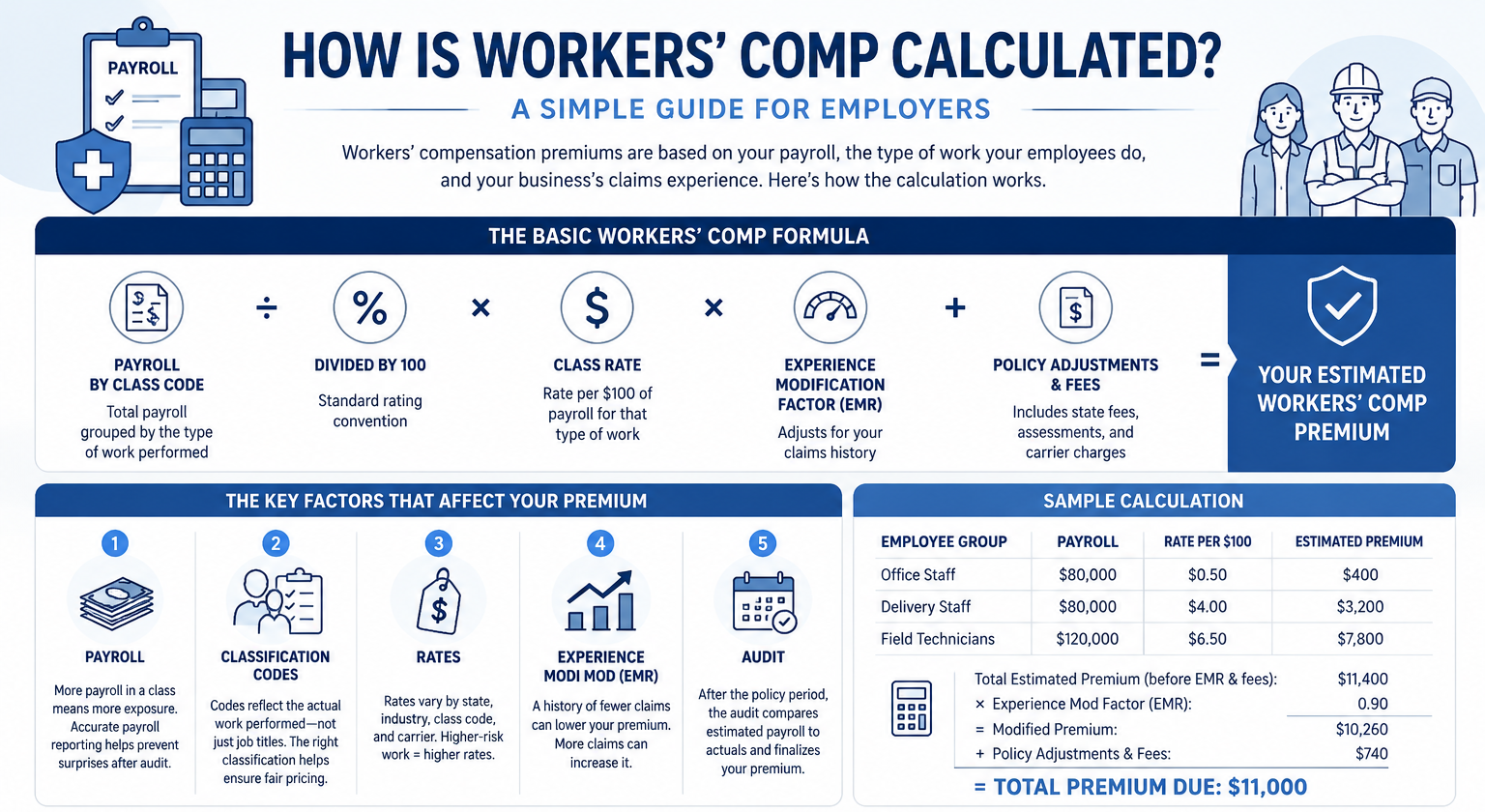
Workers’ compensation can feel hard to understand because the final premium is not based on one simple number. It is shaped by payroll, employee job duties, classification codes, rates, claims history, and the final audit.
At a high level, workers’ comp is usually calculated by applying a rate to payroll based on the type of work employees perform. In simple terms:
Workers’ comp premium = payroll by class code ÷ 100 × class rate × experience modification factor, plus applicable policy adjustments or fees. That formula can look straightforward, but the details matter. Two businesses with the same number of employees can pay very different premiums if their employees do different types of work, have different payroll totals, operate in different states, or have different claims histories.
This guide explains the main factors that affect workers’ comp premiums, why premiums can change during the year, and how Pay As You Go workers’ comp can help make payments more accurate and easier to manage.
What Is Workers’ Comp Premium?
A workers’ comp premium is the amount a business pays for workers’ compensation insurance coverage.
Workers’ compensation insurance helps provide benefits to employees who are injured or become ill because of their work. The cost of that coverage is usually connected to the business’s payroll and risk level.
For employers, the premium is not simply based on how many employees they have. It is more closely tied to how much payroll the business has, what kind of work employees do, how those roles are classified, and how the business’s claims history compares to similar businesses.
That is why a bookkeeping company and a roofing company may have very different workers’ comp premiums, even if both have ten employees. The risk connected to the work is not the same.
The Basic Workers’ Comp Calculation
The most common way to explain workers’ comp calculation is:
Payroll ÷ 100 × workers’ comp rate = estimated premium
If an employee group has $100,000 in payroll and the rate for that type of work is $2.00 per $100 of payroll, the base calculation would look like this:
$100,000 ÷ 100 = 1,000
1,000 × $2.00 = $2,000 estimated premium
That is the simplified version. In real life, the final premium may also be affected by experience modification, policy fees, state rules, carrier adjustments, and the final premium audit.
The main point for business owners is this: workers’ comp is closely tied to payroll and job classification. If payroll changes or employees are classified incorrectly, the premium can change too.
Factor 1: Payroll
Payroll is one of the biggest drivers of workers’ comp premium.
The more payroll a business has in a covered job category, the more exposure the policy is covering. That does not mean every payroll dollar is treated the same way. Payroll is usually grouped by employee classification, which reflects the type of work being done.
For example, a company might have:
- Office employees
- Drivers
- Warehouse employees
- Field technicians
- Installation workers
- Sales staff
- Seasonal staff
Each group may have a different classification and rate. A person doing clerical work in an office will usually not carry the same workers’ comp risk as someone installing equipment, driving between job sites, or working with heavy tools.
That is why accurate payroll reporting matters. If payroll is estimated too low at the beginning of the policy year, the business may owe more after the audit. If payroll is estimated too high, the business may have more cash tied up in premium payments than needed during the year.
Factor 2: Employee Classification Codes
Employee classification codes, often called class codes, help identify the type of work employees perform.
These codes are important because different types of work carry different levels of risk. A lower-risk office role may have a lower rate. A higher-risk trade, field, or manual labour role may have a higher rate.
The class code should reflect the actual work being performed, not just the employee’s title.
For example:
- A person who answers phones and handles invoices may be treated differently than a person who loads trucks.
- A project manager who only visits job sites occasionally may not be classified the same way as a full-time field technician.
- A delivery employee may have different exposure than an in-store employee.
This is one reason workers’ comp audits can become stressful. If the carrier or auditor believes payroll was assigned to the wrong class code, the premium may need to be adjusted.
The safest approach is to keep job duties, payroll records, and classification details as accurate as possible throughout the policy year.
Factor 3: Workers’ Comp Rates
Once payroll is grouped by class code, a rate is applied.
Workers’ comp rates are commonly shown as a dollar amount per $100 of payroll. The rate reflects the risk connected to that class of work and can vary by state, industry, classification, and carrier.
For example, if one class code has a rate of $1.50 per $100 of payroll and another has a rate of $6.00 per $100 of payroll, the second class will generate a higher premium for the same payroll amount.
This is why class codes matter so much. A classification issue can quickly affect the premium calculation.
Here is a simple example:
| Employee Group | Payroll | Rate Per $100 Payroll | Estimated Premium |
| Office staff | $80,000 | $0.50 | $400 |
| Delivery staff | $80,000 | $4.00 | $3,200 |
The payroll amount is the same, but the estimated premium is very different because the type of work and rate are different.
Factor 4: Experience Modification
Some employers may have an experience modification factor, often called an experience mod or mod factor.
This factor reflects the business’s past workers’ comp claims experience compared to what is expected for similar businesses. A factor above 1.00 may increase premium. A factor below 1.00 may reduce premium. A factor of 1.00 is generally neutral.
For example:
- A 1.20 mod could increase the premium calculation.
- A 0.85 mod could reduce the premium calculation.
- A 1.00 mod would leave that part of the calculation unchanged.
Not every small or new business will have an experience modification factor. Eligibility and calculation rules vary, but for businesses that do have one, it can be an important part of the premium.
This is one reason workplace safety, claims management, and accurate reporting matter over time. Claims history can affect future premium calculations.
Factor 5: Policy Fees, State Rules, and Carrier Adjustments
The basic formula is helpful, but it may not show every line item on a workers’ comp policy.
Depending on the policy, location, carrier, and applicable rules, there may be other items that affect the final amount. These can include policy fees, assessments, credits, debits, minimum premiums, or state specific adjustments.
Business owners do not need to memorize every possible adjustment. What matters is understanding that the premium is not always just payroll multiplied by a rate. The final amount may include other approved policy components.
That is why it is important to review policy documents, payroll reports, audit results, and carrier communication carefully.
Why Workers’ Comp Premiums Can Change During the Year
Your premium can change when the information behind the calculation changes.
Common reasons include:
- Payroll is higher or lower than expected
- Employees are added or removed
- Wages increase
- Job duties change
- Employees are assigned to different class codes
- The business adds a new type of work
- Operations expand to a new location
- The experience modification factor changes
- Audit results show a difference between estimated and actual payroll
For example, a small HVAC company may start the year with three technicians and one office employee. Halfway through the year, the company hires two more technicians and adds weekend emergency service. That business may have more payroll and possibly more exposure than originally estimated.
If the billing is based on the original estimate, the final audit may create a balance due.
What Happens During a Workers’ Comp Audit?
A workers’ comp audit usually happens after the policy period ends.
The purpose is to compare the estimated payroll and business information used to price the policy against what actually happened during the policy period. The audit may review payroll, job classifications, business operations, policy dates, and supporting documentation.
If the business had more payroll than estimated, the final premium may increase. If payroll was lower than estimated, the premium may be adjusted down. If payroll was assigned to the wrong class code, the premium may also change.
The audit is where many business owners feel surprised because they may not realize how much payroll, job duties, documentation, and class codes affect the final result.
That is why keeping records organized throughout the year is important.
Why Estimated Payroll Can Lead to Surprise Bills
Estimated payroll is a forecast. Actual payroll is what happened.
At the start of a policy term, a business may estimate payroll based on expected staffing, hours, wages, and operations. But many businesses do not stay exactly the same for twelve months.
A restaurant may hire more servers during patio season. A cleaning company may win a new contract and add evening staff. A warehouse may increase hours before the holidays. A contractor may take on a larger project and add field workers for several months.
If those payroll changes are not reflected in premium payments during the year, the audit may reveal a gap between estimated payroll and actual payroll.
That gap can turn into a surprise bill.
How Pay As You Go Workers’ Comp Helps
Pay As You Go workers’ comp helps by using actual payroll data more often.
Instead of relying mainly on an annual estimate, Pay As You Go calculates and collects premiums with each payroll run. That means payments follow payroll more closely throughout the year.
With RPM, the process is fully managed. RPM links with your payroll provider and current insurance carrier, calculates premiums based on payroll activity, collects the correct amount, and sends payment to the carrier.
For business owners, this can help reduce the gap between estimated payroll and actual payroll. It can also support better cash flow because payments are made in smaller payroll based amounts instead of larger upfront payments.
Pay As You Go does not change the workers’ comp policy itself. Your carrier still issues the policy. Rates, class codes, underwriting rules, and audits still matter. What changes is how payroll is used for premium payments throughout the year.
How RPM Helps With Audit Accuracy
Premium accuracy does not stop after each payroll run. Audit review still matters.
RPM’s Audit Reviews help clients review payroll data, class codes, documentation, and carrier communication. That support can be especially helpful when audit results show discrepancies or when a business owner is unsure whether the final numbers are accurate.
This matters because audits can involve several details at once:
- Was payroll reported correctly?
- Were employees assigned to the right class codes?
- Did the policy dates match the payroll period being reviewed?
- Were payroll changes documented clearly?
- Are there discrepancies that need to be resolved with the carrier?
When those details are reviewed carefully, business owners can move forward with more confidence.
How Employers Can Help Keep Workers’ Comp Premiums Accurate
Business owners do not need to become workers’ comp experts, but they should keep the right information current.
Here are practical ways to help keep premiums accurate:
Keep payroll records organized
Payroll records should clearly show employee wages, payroll periods, and any changes that happen during the year.
Track changes in job duties
If an employee’s role changes, make sure the change is documented. Job duties can affect classification.
Watch new hires and seasonal staff
New employees, temporary workers, and seasonal staff can change payroll exposure.
Review class code questions early
If you are unsure whether an employee is classified correctly, ask before audit time.
Keep audit notices and carrier communication
Do not ignore audit notices. Keep records organized and respond with accurate information.
Is Pay As You Go a Better Way to Manage Workers’ Comp Premiums?
Pay As You Go is a better fit for businesses that want premium payments to follow actual payroll more closely.
It may be especially useful for employers that:
- Have changing payroll
- Hire seasonally
- Add or reduce staff during the year
- Want smaller per-pay-period payments
- Want to reduce large upfront premiums
- Want fewer surprises at audit time
- Want less manual reporting
- Want support from workers’ comp specialists
For many employers, the value is not just in how premiums are calculated. It is in how the payment process is managed throughout the year.
Pay As You Go workers’ comp helps make the process more accurate by calculating and collecting premiums with each payroll run based on actual payroll. With RPM, business owners can keep their current payroll provider and insurance carrier while getting support through premium payments, payroll reporting, and audit review.
If you want workers’ comp payments that better reflect your real payroll, RPM can help you get started.
About Reliable Premium Management
Reliable Premium Management (RPM) helps businesses, agents, and carriers make workers’ comp simple and predictable. With real-time Pay As You Go premiums, hands-on audit support, and a team that’s always here for you, RPM delivers confidence and clarity to more than 10,000 clients nationwide.
Want to learn more?