


Pay As You Go
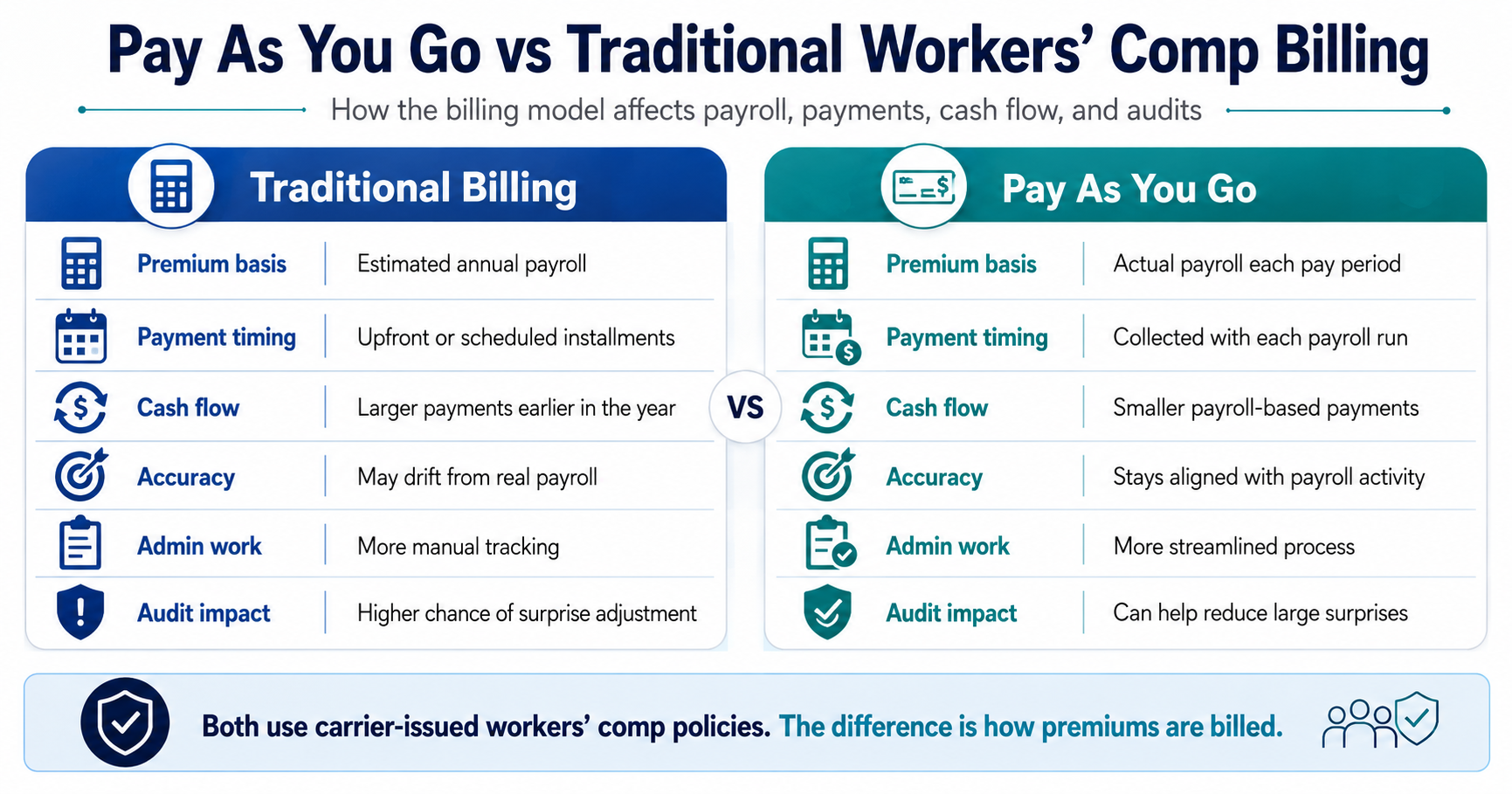
Workers’ compensation premiums are usually tied to payroll, but the way those premiums are billed can make a major difference for your business.
With traditional workers’ comp billing, many businesses pay based on estimated payroll. That can mean larger upfront costs, scheduled installment payments, and a final adjustment after the policy period ends. With Pay As You Go workers’ comp, premiums are calculated and collected with each payroll run, using actual payroll data instead of relying only on yearly estimates.
The coverage itself does not become a different type of insurance. Your workers’ comp policy is still issued by your insurance carrier. Rates, class codes, underwriting rules, and audits still matter. What changes is the billing process and how closely your payments follow your real payroll activity throughout the year.
For business owners, that difference can affect cash flow, administrative time, audit preparation, and the likelihood of unexpected premium balances.
Quick Comparison: Pay As You Go vs. Traditional Workers’ Comp Billing
|
Category |
Traditional Workers’ Comp Billing |
Pay As You Go Workers’ Comp Billing |
| How premiums are billed | Often based on estimated annual payroll | Based on actual payroll each pay period |
| Payment timing | Often upfront or scheduled installments | Collected with each payroll run |
| Cash flow impact | Can require larger payments earlier in the policy term | Breaks premium payments into smaller payroll-based amounts |
| Payroll accuracy | Estimates may not reflect business changes during the year | Payments adjust as payroll changes |
| Audit risk | Final audit may create a larger adjustment if estimates were off | More current payroll data can help reduce large surprises |
| Admin work | May involve more manual tracking and reconciliation | RPM manages payroll data flow and payments |
| Policy structure | Policy is still issued by the carrier | Policy is still issued by the carrier |
| Audits | Still apply | Still apply |
What Is Traditional Workers’ Comp Billing?
Traditional workers’ comp billing typically starts with an estimate.
At the beginning of the policy period, the carrier or insurance provider uses projected payroll, job classifications, rates, and other policy details to estimate the premium for the year. The business may pay a deposit, make installment payments, or follow another billing schedule based on that projection.
The challenge is that payroll rarely stays perfectly flat.
Your business may hire new employees, reduce staff, increase wages, add new job roles, change operations, or experience seasonal swings. If your actual payroll ends up being higher or lower than the original estimate, the final premium may need to be adjusted after the audit.
That is where many business owners feel the pressure. A billing model built around estimates can create a gap between what you paid during the year and what your final premium should have been based on actual payroll.
What Is Pay As You Go Workers’ Comp Billing?
Pay As You Go workers’ comp billing uses a different payment plan.
Instead of calculating premium payments primarily from an annual estimate, premiums are calculated and collected with each payroll run. That means the premium payment is tied more closely to what your business actually paid in wages during that payroll period.
For example, if payroll increases, your workers’ comp payment adjusts with it. If payroll decreases, your payment reflects that change as well. The goal is to keep premium payments more aligned with your business in real time.
With RPM, the process is fully managed. RPM connects with your existing payroll provider and current insurance carrier, calculates premiums based on payroll activity, collects the correct amount, and sends payments to the carrier. That means business owners do not need to switch payroll providers or carriers to use the service.
The Biggest Difference: Estimated Payroll vs. Actual Payroll
The most important difference between traditional billing and Pay As You Go billing is how payroll is used.
Traditional billing often starts with projected payroll. That projection may be reasonable at the time, but it is still a forecast. If the business changes, the original estimate can quickly become outdated.
Pay As You Go billing uses actual payroll data each pay period. That gives the payment process a more accurate foundation throughout the policy term.
This matters because workers’ comp premium is closely connected to payroll. When payroll is not tracked accurately throughout the year, the audit can reveal a larger difference between estimated exposure and actual exposure. Pay As You Go does not remove the audit, but it helps keep billing more current along the way.
The Cash Flow Difference
Cash flow is one of the biggest reasons business owners look at Pay As You Go workers’ comp.
Traditional billing can create larger payment obligations early in the policy term. Even when payments are broken into installments, those payments are still often based on an estimate. For a growing, seasonal, or changing business, that can feel disconnected from what is actually happening in payroll.
Pay As You Go billing spreads workers’ comp payments across payroll cycles. This can make payments feel more manageable because they move with payroll rather than sitting separately as a larger insurance bill.
For many business owners, the advantage is not just “smaller payments.” It is better timing. Premium payments are made closer to when payroll is actually run, which helps reduce the financial strain of large upfront deposits or delayed year-end adjustments.
What Changes With Pay As You Go?
Pay As You Go changes the payment process, not the purpose of workers’ comp insurance.
The key changes include:
Premiums are calculated more frequently: Instead of relying mainly on an annual estimate, premiums are calculated each payroll period.
Payments follow payroll activity: Your workers’ comp payment is tied to your actual payroll activity, which helps keep billing more aligned with your business throughout the year.
Payroll reporting becomes more streamlined: With RPM, the payroll data flow is managed for you. This reduces the need for business owners to manually report payroll data or track every payment step on their own.
Cash flow becomes easier to manage: Paying with each payroll cycle can reduce the pressure of larger upfront premium payments.
Audit preparation becomes less stressful: Because payroll information is kept more current throughout the policy term, there is less guesswork when audit time comes around.
What Stays the Same?
Pay As You Go is a billing method. It does not remove the core requirements of workers’ comp insurance.
Here is what stays the same:
Your policy is still issued by the carrier: Pay As You Go does not replace your insurance carrier. Your workers’ comp policy remains with the carrier.
Rates and class codes still matter: Pay As You Go does not change how workers’ comp rates, classifications, or underwriting rules are determined. Accurate class codes and payroll details are still important.
Audits still happen: Pay As You Go helps keep premium payments closer to actual payroll, but audits still remain part of the workers’ comp policy cycle.
Business changes still need to be communicated: If your operations change, your job roles shift, or your payroll structure changes, those details still matter. Pay As You Go improves the billing process, but it does not replace the need for accurate business and payroll information.
Why the Billing Model Matters
Workers’ comp billing is not just an accounting detail. It can affect how confident you feel throughout the year.
Traditional billing can work, but it often puts more pressure on estimates. If the estimate is too low, the audit may result in a balance due. If the estimate is too high, you may have tied up cash that could have stayed in your business.
Pay As You Go gives business owners a more active, payroll-based payment model. By connecting premiums to actual payroll activity, it can help reduce uncertainty and make workers’ comp feel less disconnected from the way the business actually runs.
For many businesses, the value is practical:
- Less money tied up in upfront premium payments
- Fewer manual reporting steps
- More accurate premium calculations throughout the year
- Better alignment between payroll and workers’ comp payments
- More support when questions or audit needs come up
How RPM Makes Pay As You Go Easier
Not every Pay As You Go setup feels the same. Some models may still require manual reporting, platform logins, or extra administrative steps.
RPM’s service is designed to be hands-on. RPM connects with your payroll provider and insurance carrier, manages the payroll data flow, calculates premiums each pay cycle, collects the correct payment, and sends it to the carrier.
For business owners, that means fewer moving parts. You do not need to switch payroll providers. You do not need to change carriers. You do not need to manage the process alone.
RPM also provides human support when questions, updates, or audit needs come up. That matters because workers’ comp is not always simple. Payroll changes, class codes, audit notices, and policy details can all affect the final result. Having a team involved throughout the year can help make the process feel more controlled and less reactive.
Does Pay As You Go Eliminate Workers’ Comp Audits?
No. Pay As You Go does not eliminate workers’ comp audits.
Audits are still part of the workers’ comp process. The difference is that Pay As You Go helps keep premium payments more aligned with payroll throughout the year, which can reduce the chance of a large adjustment at the end of the policy period.
RPM also supports audit reviews for clients. That means the team can help review payroll data, class codes, documentation, and carrier communication so the audit process is more organized and accurate.
In other words, Pay As You Go helps improve the billing process during the year, while audit support helps bring clarity at the end of the policy term.
Which Billing Model Is Better for Your Business?
The right billing model depends on how your business operates.
Traditional billing may feel familiar, especially for businesses with stable payroll and predictable staffing. But for businesses with changing payroll, seasonal staffing, cash flow concerns, or past audit surprises, Pay As You Go may offer a more flexible and accurate way to manage workers’ comp payments.
Pay As You Go may be especially helpful if your business wants to:
- Reduce large upfront premium payments
- Align payments with real payroll activity
- Improve cash flow throughout the year
- Reduce manual payroll reporting
- Minimize audit-related surprises
- Keep your current payroll provider and carrier
- Get support from real workers’ comp specialists
Frequently Asked Questions
Is Pay As You Go workers’ comp different from workers’ comp insurance?
Pay As You Go is not a different type of workers’ comp coverage. It is a billing method that calculates and collects premiums based on actual payroll each pay period.
Does Pay As You Go change my workers’ comp carrier?
No. With RPM, you can keep your current insurance carrier and payroll provider. RPM connects the payroll and payment process so premiums can be calculated and sent accurately.
Does Pay As You Go remove the workers’ comp audit?
No. Audits still apply. Pay As You Go helps keep payments more aligned with payroll during the policy term, which can help reduce large surprises at audit time.
Why is Pay As You Go better for cash flow?
Pay As You Go breaks premium payments into payroll-based payments instead of relying on larger upfront amounts or estimate-based installments. This helps keep more cash available in the business throughout the year.
What is the main difference between Pay As You Go and traditional workers’ comp billing?
The main difference is timing and accuracy. Traditional billing often uses estimated annual payroll, while Pay As You Go calculates premiums from actual payroll each time payroll is run.
About Reliable Premium Management
Reliable Premium Management (RPM) helps businesses, agents, and carriers make workers’ comp simple and predictable. With real-time Pay As You Go premiums, hands-on audit support, and a team that’s always here for you, RPM delivers confidence and clarity to more than 10,000 clients nationwide.
Want to learn more?