


Workers Comp Audits
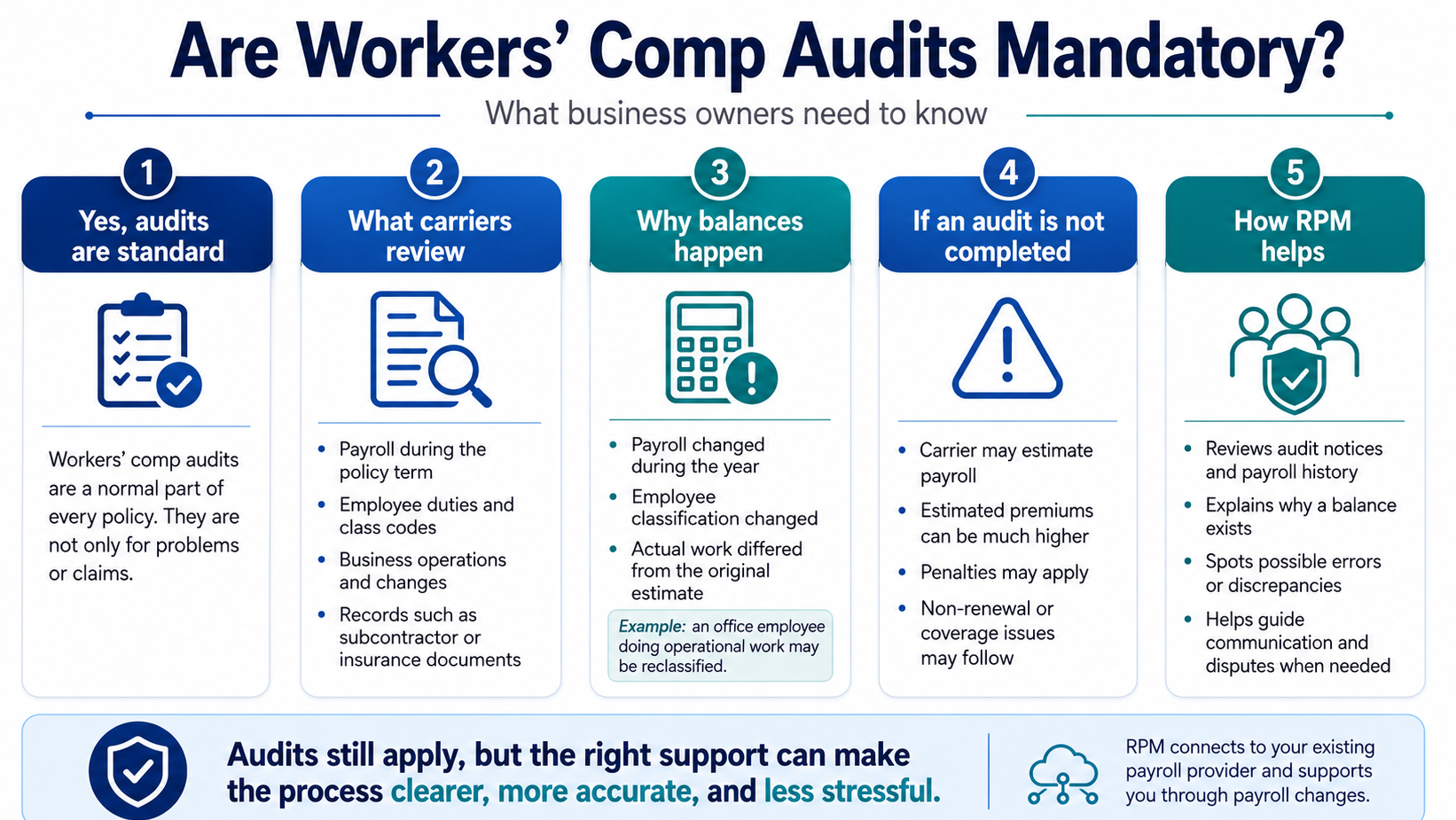
Yes, workers’ comp audits are mandatory. They are a standard contractual part of every workers’ comp policy. An audit is not a sign that something has gone wrong, an optional step, or something triggered only by issues with the account. A workers’ comp audit is used to review your business’s payroll, job classifications, and operations after the policy period ends. The goal is to confirm whether the premium paid during the year matches the business’s actual payroll and risk exposure.
This review is necessary because payroll, employee responsibilities, locations, and business operations can naturally change during the policy year. The audit helps ensure the final premium reflects what actually happened rather than relying only on the estimates provided when the policy began.
What Is a Workers’ Comp Audit?
A workers’ comp audit is a review that usually happens after the policy period ends.
When a workers’ comp policy starts, the premium is often based on estimated payroll and business information. The audit compares those estimates against what actually happened during the policy term. The auditor may review:
- Payroll paid during the policy period
- Employee job duties
- Classification codes
- Business operations
- Policy dates
- Payroll records
- Subcontractor documentation, if applicable
- Certificates of insurance, if applicable
- Supporting documents requested by the carrier or auditor
If the actual information is different from the original estimate, the final premium may be adjusted.
Why Do Carriers Require Workers’ Comp Audits?
Carriers require audits because businesses change.
Payroll may increase or decrease. Employees may be hired or leave. Job duties may shift. A business may add a new service, location, or type of work. Seasonal staffing may also change the final payroll total.
For example, a landscaping company may start the policy year with a smaller crew, then add seasonal workers during the spring and summer. A retail business may increase hours during the holiday season. A contractor may take on a larger project and add temporary field staff.
Those changes can affect workers’ comp premium. The audit helps the carrier confirm whether the original estimate still matches the business’s actual activity.
One of the most common misconceptions RPM’s Audit team hears is that an audit only happens when the carrier suspects a problem. In reality, the audit is built into the policy process because the information used to estimate the original premium may no longer reflect the business at the end of the year.
What Happens After the Audit?
After the audit, the carrier finalizes the premium for the policy period.
There are usually three possible outcomes:
| Audit Result | What It Means |
|---|---|
| Additional premium is owed | Actual payroll, class codes, or exposure were higher than originally estimated. |
| Premium is adjusted down | Actual payroll or exposure was lower than originally estimated. |
| No major adjustment is needed | The original estimate was close to the actual payroll and operations. |
Even if the adjustment is small, the audit still matters because it closes out the policy period and confirms the final numbers.
Why Can a Workers’ Comp Audit Create a Balance Due?
A balance due does not always mean the business’s total payroll increased. Employee classification can have an equally important effect on the final premium.
Class codes are intended to reflect the work employees actually perform. For example, a business may assume that an employee qualifies for a clerical classification because the person works in an office. However, if that employee regularly performs operational work, visits job sites, handles inventory, or completes duties outside a strictly clerical role, the auditor may assign the payroll to a higher risk classification.
In that situation, the business may receive a balance due even if its total payroll did not change. The difference comes from the rate applied to that payroll. Other common reasons for a balance include:
- Payroll being higher than originally estimated
- Employees taking on different duties during the year
- A new location or business operation being added
- Payroll being reported under an incorrect class code
- Subcontractor documentation being incomplete
- Payroll information being duplicated or assigned incorrectly
- The audit covering payroll that was not included in the original estimate
What Happens If You Do Not Complete a Workers’ Comp Audit?
Ignoring a workers’ comp audit can create bigger problems.
If a business does not complete the audit, the carrier may issue an estimated premium. In that situation, the carrier estimates payroll on the business’s behalf because it does not have the records needed to calculate the final premium accurately. Estimates generated by the carrier are often much higher than the amount an accurate, completed audit would produce.
Depending on the policy and situation, not completing an audit may also lead to penalties, policy cancellation, non-renewal, or further action.
Completing the audit gives the business an opportunity to provide accurate payroll, classification, and operational information rather than allowing the final premium to be based on assumptions.
The best approach is not to ignore the audit notice. Review it, gather the requested information, and ask for help if anything is unclear.
Why Workers’ Comp Audits Can Feel Stressful
Audits can feel overwhelming because they combine several detailed areas of the business at once.
A business owner may need to explain payroll, employee roles, subcontractor records, policy dates, and class codes. If the business changed during the year, the audit may also need extra context.
The process can feel especially frustrating when an auditor is reviewing the account for the first time and does not already understand the business. That is where errors or confusion can happen.
A business owner may see a balance due without immediately understanding which payroll entry, class code, policy period, or reporting issue caused it. That is why reviewing the details behind the result is just as important as reviewing the final number.
Customer Testimonial
“Reliable Premium was one of the best payroll and insurance-related companies that I have ever done business with. They made the setup and moving forward process easy. Our Workers’ Comp and General Liability auditors loved the easy-to-understand per-payroll PAYGO data. They made my job much easier, especially for audits.” — Jessica Lyons, Rays Restaurant
How RPM Helps With Workers’ Comp Audits
RPM’s Audit Reviews help business owners move through the audit process with more clarity and less stress. RPM can help by:
- Reviewing audit notices and payroll reports
- Checking payroll data
- Verifying class codes and documentation
- Reviewing policy dates and audit details
- Communicating with the carrier
- Identifying discrepancies
- Helping resolve questions or issues
- Walking the business owner through the audit findings
- Comparing the audit results against the client’s payroll history and RPM invoicing
- Explaining exactly why a balance exists
- Identifying potential inaccuracies in the auditor’s findings
- Helping guide clients through the dispute process when a correction may be appropriate
This matters because small details can affect the final result. A payroll reporting issue, classification question, missing document, or policy date mismatch can create confusion if it is not reviewed carefully.
RPM’s role is not limited to forwarding documents. The Audit team reviews how the final figures were reached and helps clients understand whether the result is supported by their actual payroll and policy history.
A Real Example of Why Audit Review Matters
RPM recently supported a multi-location client whose payroll had been inadvertently counted twice because of how it was reported across multiple Federal Employer Identification Numbers, or FEINs. The original audit appeared to show a balance of approximately $32,500.
During the audit review, RPM identified the duplicate payroll, worked with the carrier, and helped reduce the final balance to approximately $500.
Not every audit will involve an error of this size, but the example shows why business owners should understand how an audit balance was calculated before accepting the result at face value.
Advice From the RPM Audit Team
“When you receive an audit notice, reach out to us before you do anything else. We can explain every single line of that audit, identify anything that looks off, and help you understand what you actually owe and why. You have 20+ years of human-led experience in your back pocket. Use us.”
What Should You Do When You Receive an Audit Notice?
When you receive an audit notice, take action early. Start by reviewing what the carrier or auditor is requesting. Check the policy period, deadline, and required documents. Then gather payroll reports, employee details, subcontractor records, and any supporting information.
If you are an RPM client, contact RPM before submitting the audit so the team can review the notice, help gather the correct information, and identify potential questions before the audit is finalized.
The goal is to make sure the information submitted is complete, accurate, and easy to understand.
How Can Business Owners Reduce Audit Surprises?
The RPM Audit team recommends focusing on three areas throughout the policy year.
1. Treat class codes like job descriptions, not labels
An employee’s classification should reflect the work that person actually performs every day, not simply their title or where they spend most of their time.
For example, an employee may have an office-based title but regularly complete field or operational work. In that situation, an auditor may determine that a strictly clerical classification does not accurately reflect the employee’s responsibilities. The auditor reviews the work that was actually performed rather than averaging different duties together.
The classifications assigned when the policy begins establish what the auditor expects to find at the end of the policy period. If those classifications do not match the work employees actually perform, the difference can affect the final premium.
2. Keep classifications current as the business changes
Businesses that consistently experience cleaner audits tend to review classifications carefully when the policy begins and remain aware of changes throughout the year.
Business owners should notify their insurance contacts when:
- An employee’s regular responsibilities change
- Someone who previously worked behind a desk begins spending time in the field
- A new business location opens
- A new service or operation is added
- Employees move between office and operational roles
- Seasonal or temporary positions are introduced
- The business changes how payroll is reported
These updates matter because a policy based on outdated job duties or business operations may not match what the auditor finds at the end of the year.
3. Make sure the policy and business records tell the same story
The goal is not to add unnecessary complexity to the policy. It is to ensure that the policy, payroll records, employee duties, locations, and audit information all reflect how the business actually operated during the policy period.
When job classifications, payroll records, and operational details remain consistent, the auditor is more likely to see the same picture the business owner sees. That alignment can help reduce confusion and unexpected premium adjustments.
To Sum It Up
Yes, workers’ comp audits should be treated as mandatory. They are a standard contractual part of the workers’ comp policy and are not limited to businesses where something has gone wrong.
The audit confirms whether the payroll, class codes, and business operations estimated at the start of the policy match what actually happened during the policy period. If the information is different, the final premium may change.
Failing to complete the audit can lead to estimated premiums, penalties, cancellation, non-renewal, or further action depending on the policy and situation. Because payroll estimates generated by the carrier can be significantly higher than actual payroll, completing the audit with accurate documentation is usually in the business owner’s best interest.
The best way to reduce audit stress is to stay organized, respond early, keep classifications aligned with actual employee duties, and get support when the process feels unclear.
RPM helps clients compare audit results against payroll history and invoicing, understand why a balance exists, identify potential inaccuracies, communicate with the carrier, and navigate a dispute when appropriate. Business owners do not have to manage the audit alone.
If you have questions about your workers’ comp audit, RPM can help you get started!
About Reliable Premium Management
Reliable Premium Management (RPM) helps businesses, agents, and carriers make workers’ comp simple and predictable. With real-time Pay As You Go premiums, hands-on audit support, and a team that’s always here for you, RPM delivers confidence and clarity to more than 10,000 clients nationwide.
Want to learn more?